Organic Skin & Hair Care
Organic Skin & Hair Care
If your face feels tight after washing, looks dull by afternoon, or develops rough and flaky patches no matter how much cream you apply, the problem may not simply be that you need a “heavier” moisturizer.
Dry skin needs the right kind of moisture support.
A good moisturizer should help hydrate the skin, soften roughness and reduce moisture loss. The best choice also depends on your skin type, the texture you can comfortably wear, your skincare routine and, in Pakistan, the season and environment you’re dealing with.
That is why choosing the best moisturizer for dry skin is not really about finding the thickest cream on the shelf.
It is about finding the right formula for your skin.
The best moisturizer for dry skin is one that provides hydration while helping the skin retain moisture without leaving an uncomfortable, greasy layer.
Ingredients such as hyaluronic acid, glycerin, ceramides, aloe vera, emollients and occlusives can play different roles in maintaining comfortable, hydrated skin. Dermatology guidance commonly recommends ingredients such as hyaluronic acid, ceramides and glycerin for dry skin, while richer creams or ointments can be useful when dryness is more pronounced.
But there is no single moisturizer that is automatically best for every person.
Someone with mildly dry skin in Lahore’s summer may prefer a lightweight hydrating formula. Someone dealing with very dry, flaky skin during winter may prefer something richer.
And someone with dry-looking but oily skin may actually be dealing with dehydration rather than naturally dry skin.
That distinction matters.
This is one of the most overlooked parts of choosing a moisturizer.
Dry skin describes a skin type or tendency associated with insufficient oil/lipid content.
Dehydrated skin describes a lack of water.
They can look similar. Both can cause tightness, dullness and rough texture. But the underlying issue isn’t necessarily identical.
For example, you might notice that your cheeks feel tight while your forehead becomes oily later in the day. That does not automatically mean you have oily skin and should stop moisturizing.
Your skin may simply be dehydrated.
A useful moisturizer routine can support both conditions, but product texture may need to be adjusted according to how your skin behaves.
This is why blindly buying the richest cream available isn’t always the smartest approach.
Several everyday habits and environmental factors can contribute to dryness.
Common triggers include:
The outer layer of your skin acts as a protective barrier. When that barrier becomes compromised, the skin can lose water more easily and become rough, tight or irritated.
Dermatology guidance also recommends avoiding overly harsh cleansing and paying attention to potentially irritating ingredients, especially when skin is already dry or sensitive.
This explains why someone can use an expensive moisturizer and still complain:
“Meri skin phir bhi dry ho jati hai.”
Sometimes the moisturizer isn’t the only problem.
The cleanser, shower temperature, exfoliation habits and overall routine may be working against it.
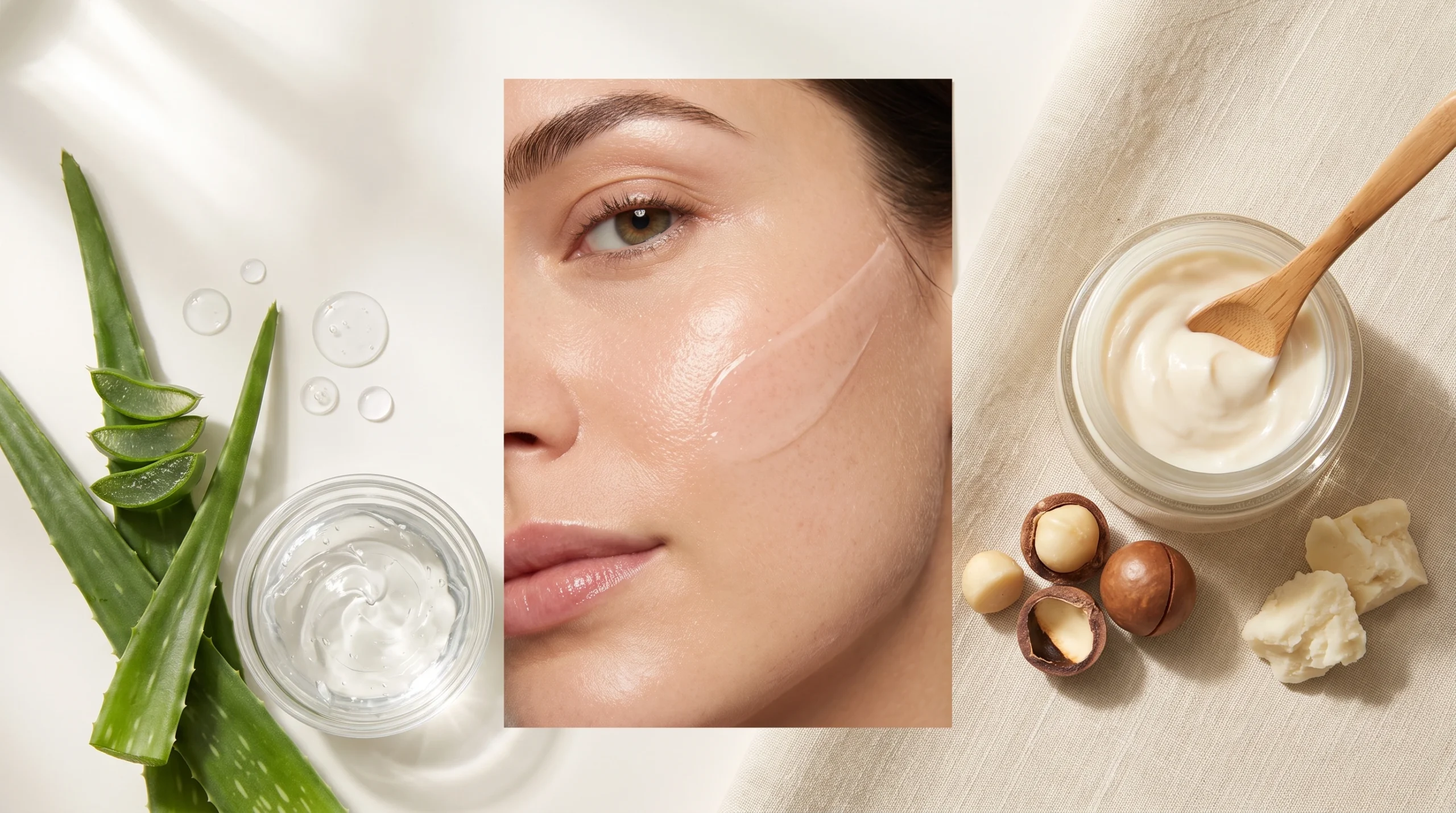
Instead of judging a moisturizer only by its brand name or how thick it feels, learn what its ingredients are actually doing.
A useful way to understand moisturizers is through three groups:
Humectants help attract and hold water.
Common examples include:
Hyaluronic acid is particularly popular because of its ability to support skin hydration. It is widely used in products designed for dry or dehydrated skin.
Emollients help soften and smooth the skin.
They can make rough, dry skin feel more comfortable by improving the feel and flexibility of the skin surface.
Examples can include certain plant oils, fatty components and other skin-softening ingredients.
Occlusives help reduce water loss by forming a protective layer over the skin.
Examples include petrolatum, mineral oil and certain silicones.
For very dry skin, occlusive ingredients can be particularly useful because hydration is only part of the equation.
You also need to help keep that moisture from escaping.
Hyaluronic acid has become one of the most recognizable skincare ingredients for a reason.
It functions as a humectant, helping the skin retain water and giving a more hydrated, supple appearance.
But there is a common misunderstanding:
Hyaluronic acid alone isn’t necessarily the entire solution for very dry skin.
If your skin is severely dry, you may also benefit from ingredients that soften the skin and help reduce moisture loss.
Think of it this way:
Humectant = helps bring/hold water
Emollient = helps soften
Occlusive = helps reduce moisture escaping
A well-designed moisturizer can bring several of these functions together.
That is a much more useful way to judge a product than simply seeing “hyaluronic acid” on the front label.
Ceramides are naturally occurring lipids found in the skin barrier.
They are particularly relevant when your skin feels dry, rough or compromised because the skin barrier plays a major role in retaining moisture.
Ceramide-containing moisturizers are frequently recommended for supporting the skin barrier, and dermatology sources identify ceramides as useful ingredients for dry skin.
However, don’t turn the ingredient list into a competition where the moisturizer with the longest list automatically wins.
The overall formulation, texture, tolerability and your skin’s needs matter.
Aloe vera is commonly used in skincare for its soothing and refreshing properties.
For someone whose skin feels uncomfortable after cleansing or exposure to heat, a moisturizer containing aloe vera can be appealing because hydration doesn’t have to mean a heavy texture.
For sensitive skin, however, “natural” should never automatically be interpreted as “risk-free.”
The American Academy of Dermatology specifically cautions that natural or organic skincare ingredients can still cause allergic reactions in some people.
So if your skin is reactive, patch testing remains sensible even when a formula contains mostly familiar botanical ingredients.
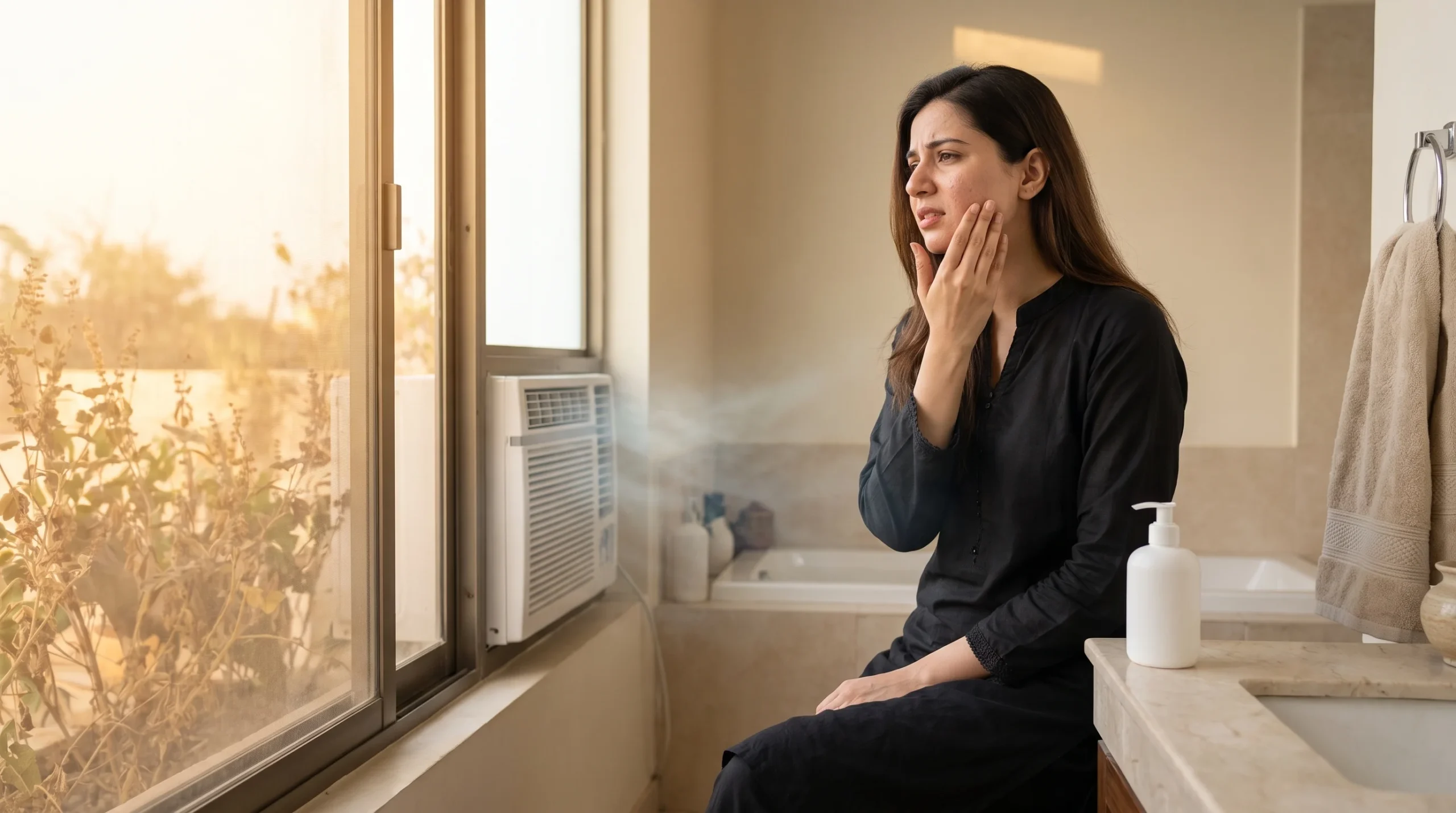
Pakistan doesn’t have one single skincare climate.
That’s an important point.
The experience of dry skin in Islamabad during winter isn’t necessarily the same as dry skin in Karachi during a humid summer.
Likewise, someone spending most of the day in an air-conditioned office may experience dryness even when the outdoor weather is hot.
Current Pakistani skincare guides increasingly recognize this seasonal difference and recommend adjusting moisturizer texture according to climate — lighter formulas during warmer, more humid periods and richer formulas when dryness is more severe.
You may prefer:
You may prefer:
There is no prize for choosing the heaviest moisturizer.
The best moisturizer is the one you can comfortably use consistently.
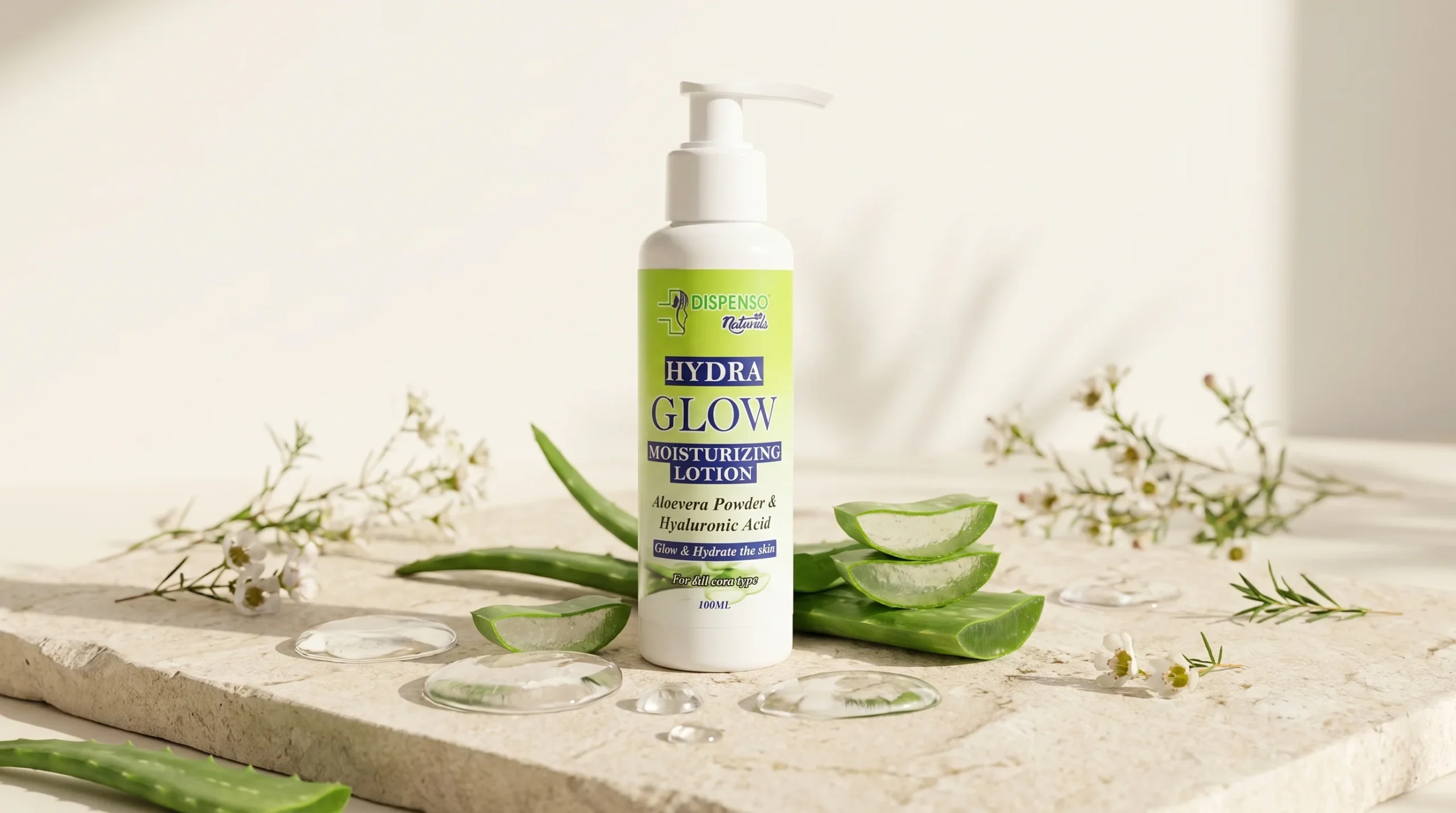
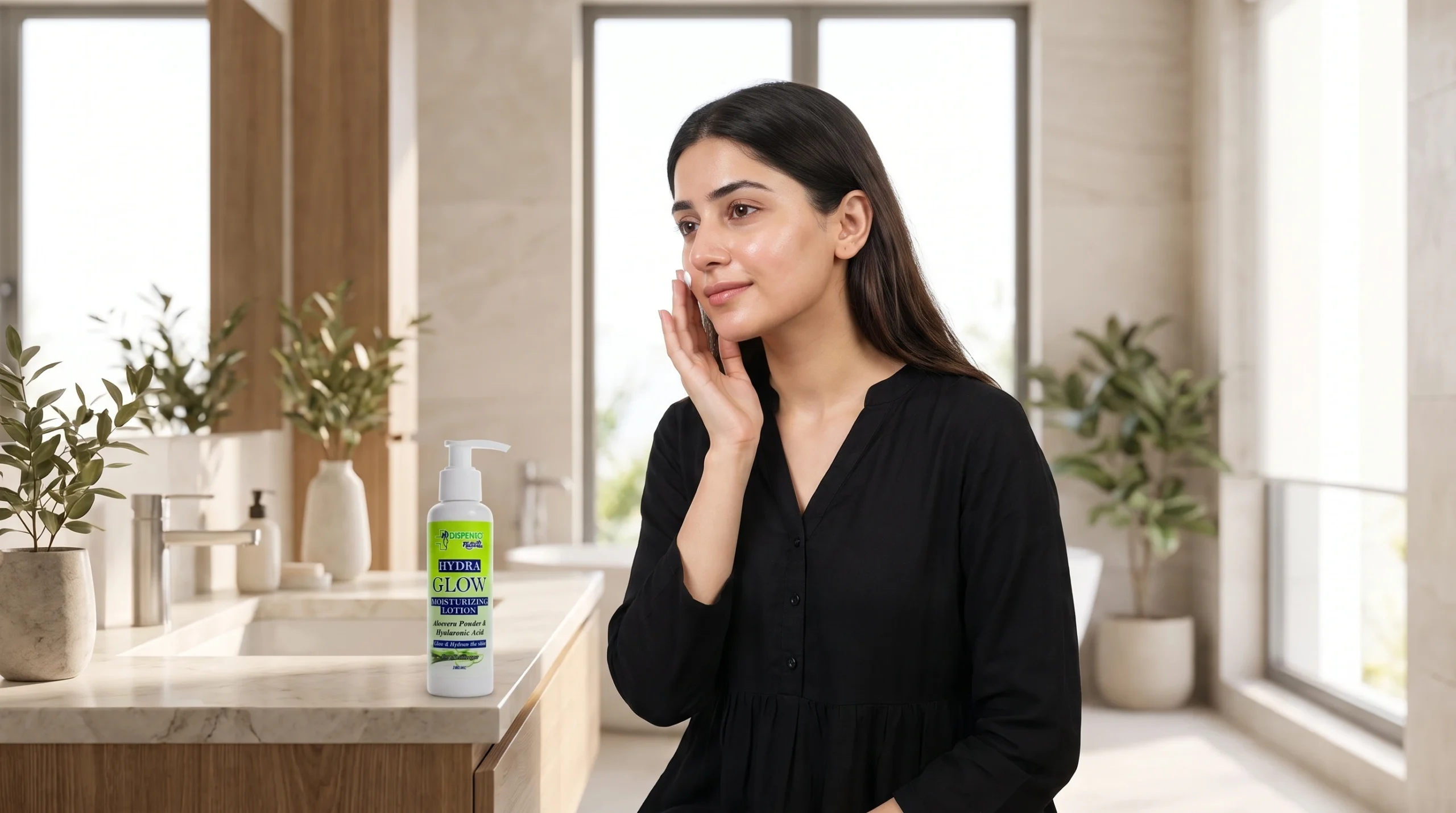
For people looking for a lightweight daily moisturizer with hydration and brightening support, Dispenso Naturals Hydra Glow Moisturizer is designed around a simple idea:
Hydration should feel comfortable enough to become part of your everyday routine.
The 100 ml Hydra Glow Moisturizer combines:
It is formulated for oily, dry, sensitive and other skin types, with a texture intended to absorb without leaving the heavy feeling that some dry-skin creams can create.
Lightweight & non-greasy:
Useful for people who want hydration without a thick cream sitting on the face.
Hydrating:
Hyaluronic acid helps support skin hydration and a plumper, softer feel.
Brightening support:
Alpha arbutin makes the formula particularly relevant for people concerned about dullness and the appearance of uneven skin tone.
Soothing:
Aloe vera powder provides a soothing component to the formula.
Makeup friendly:
Its lightweight texture can work beneath sunscreen or foundation as part of a daytime routine.
Made in Pakistan:
For consumers who prefer locally formulated skincare, Hydra Glow is formulated in Pakistan by Dispenso Naturals.
The brand describes the moisturizer as paraben-free, sulfate-free and cruelty-free, with dermatological testing and pharmacist-led formulation.
Hydra Glow can make sense if your priorities are:
If your skin is extremely dry, cracked, or persistently irritated, however, you may need a richer barrier-focused moisturizer or professional assessment rather than relying on any lightweight daily moisturizer alone.
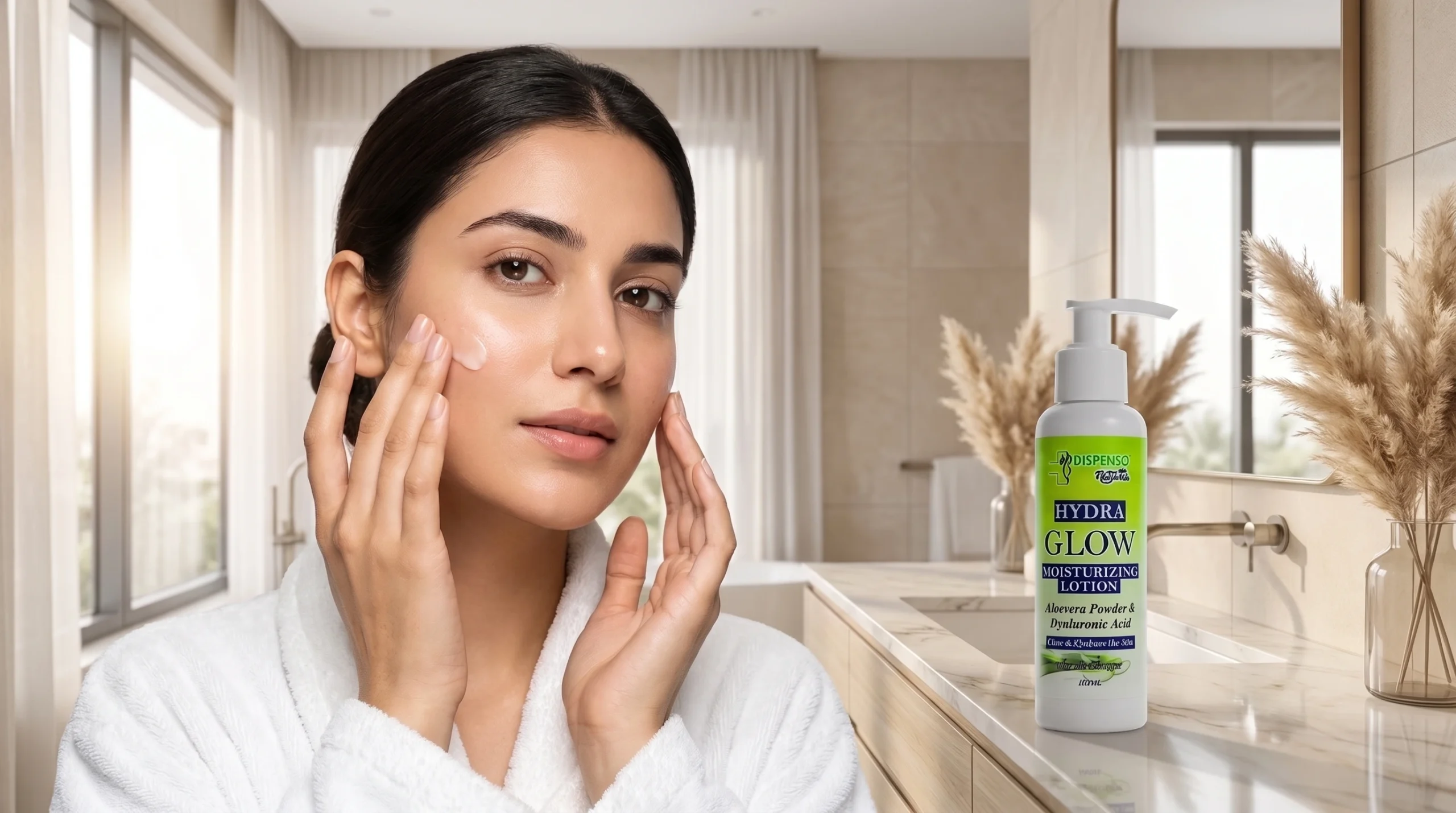
The product you buy matters.
But how you use it matters too.
Step 1: Cleanse with a gentle face wash.
Step 2: Apply serum if you use one.
Step 3: Apply moisturizer.
Step 4: Finish with sunscreen.
Step 1: Cleanse.
Step 2: Apply any treatment or serum appropriate for your routine.
Step 3: Apply moisturizer.
For dry skin, applying moisturizer shortly after washing — while the skin is still slightly damp — can help retain water. Dermatology guidance commonly recommends moisturizing soon after cleansing or bathing.
With Hydra Glow, use a small amount and massage gently until absorbed.
There is no need to aggressively rub the skin.
Yes.
For a typical morning skincare routine, moisturizer can be applied before sunscreen.
A simple sequence is:
Cleanser → Moisturizer → Sunscreen
If you use a serum:
Cleanser → Serum → Moisturizer → Sunscreen
Remember that a moisturizer and sunscreen have different jobs. A moisturizer supports hydration and skin comfort; sunscreen provides UV protection.
Don’t treat a moisturizer as a substitute for dedicated sunscreen unless the product itself is specifically formulated and labeled as sunscreen with an appropriate SPF and broad-spectrum protection.
Yes, and texture becomes especially important here.
A moisturizer that absorbs comfortably can provide a smoother-feeling base for foundation.
The trick is not to apply an excessive amount.
Give the moisturizer a little time to settle before applying makeup. If you use too many layers or too much product, pilling can become an issue.
Hydra Glow’s lightweight texture makes it suitable for this type of routine.
For most people with dry skin, moisturizing morning and night is a practical starting point.
You may need additional application if your skin becomes uncomfortable during the day, particularly in very dry conditions.
Consistency matters more than occasionally applying a huge amount of cream.
A small amount used regularly is generally more useful than a rich product that you dislike wearing and therefore keep skipping.
Glow and hydration are not the same thing.
A healthy-looking glow can be supported by good hydration, but a product should still meet your skin’s basic moisturizing needs.
A thick cream isn’t automatically better for dry skin.
Texture should match your skin condition, climate and preference.
Heat doesn’t mean your skin suddenly stops needing hydration.
You may simply prefer a lighter formula.
When skin becomes flaky, the instinct is often to scrub harder.
That can make matters worse.
Excessive exfoliation can further irritate already dry skin.
If your cleanser leaves your face feeling unusually tight, changing moisturizer alone may not solve the problem.
Persistent redness, intense itching, painful cracking or recurring rash may indicate an underlying skin condition rather than ordinary dryness.
Use a lightweight moisturizer when:
Consider a richer cream or ointment when:
Dermatology guidance generally considers creams and ointments more effective for significant dryness than lighter lotions.
Not necessarily.
Men’s and women’s skin can differ in some ways, but the basic principles of moisturization remain the same.
A man’s moisturizer doesn’t need to be marketed specifically as “for men” to moisturize effectively.
The more useful questions are:
That’s a much better decision framework than choosing skincare based only on gender.
Yes.
Oily skin can still become dehydrated.
If you have an oily T-zone but dry or tight cheeks, a lightweight moisturizer may be more appropriate than abandoning moisturizer completely.
The goal isn’t to add unnecessary heaviness.
The goal is to maintain a comfortable moisture balance with a texture your skin tolerates.
You don’t need ten products.
A basic routine can look like this:
Gentle cleanser → Hydra Glow Moisturizer → Sunscreen
Gentle cleanser → Hydra Glow Moisturizer
If you have a specific concern such as pigmentation or acne, additional treatments can be introduced thoughtfully rather than adding everything at once.
This simple approach also makes it easier to identify which product is helping or irritating your skin.
Ask yourself five questions:
A cleanser that strips the skin can undermine your moisturizer.
Hot water can worsen dryness.
Dry, flaky skin doesn’t always need more exfoliation.
A tiny dot may not be enough for your face and neck.
Persistent or severe dryness may be associated with conditions such as eczema, psoriasis or other dermatological problems. If dryness is intense, recurrent or accompanied by significant itching, inflammation or cracking, professional assessment is appropriate.
Before buying a moisturizer for dry skin in Pakistan, check:
| What to Check | Why It Matters |
|---|---|
| Skin type | Helps determine suitable texture |
| Hydrating ingredients | Support water content |
| Emollients | Help soften rough skin |
| Occlusives | Help reduce moisture loss |
| Texture | Determines everyday comfort |
| Climate | Pakistan’s weather varies considerably |
| Fragrance | Can matter for sensitive skin |
| Packaging | Helps with practical daily use |
| Size | Consider how often you will use it |
| Routine compatibility | Should work with sunscreen/makeup |
And don’t judge a moisturizer solely by price.
A more expensive product isn’t automatically more effective, while an affordable product isn’t automatically inferior. What matters is the formulation, suitability and whether you can use it consistently.
The best moisturizer depends on how dry your skin is, your preferred texture, climate and ingredient needs. Look for a formula that supports hydration and moisture retention. For lightweight daily hydration with hyaluronic acid, alpha arbutin and aloe vera, Dispenso Naturals Hydra Glow Moisturizer is one option to consider.
Yes. Hyaluronic acid is a humectant that helps attract and retain water in the skin. For very dry skin, it can be particularly useful when combined with ingredients that soften skin and reduce moisture loss.
Yes. Daily moisturizing is a core part of caring for dry skin. Morning and evening use is a practical routine for many people.
Apply moisturizer first, then sunscreen during the morning routine.
Yes. Dry skin does not automatically require a heavy cream. A lightweight moisturizer can be more comfortable, particularly in warm or humid weather.
Absolutely. Moisturizer selection should be based on skin condition and formulation rather than gender.
Yes. Hot weather does not eliminate the need for hydration. You may simply prefer a lighter texture during summer.
Yes. A lightweight moisturizer can provide a comfortable base under makeup. Allow it to absorb before applying foundation.
Commonly useful ingredients include hyaluronic acid, glycerin, ceramides, emollients and occlusives. The ideal combination depends on how dry and sensitive your skin is.
Start with a gentle cleanser, avoid very hot water, don’t over-exfoliate and apply moisturizer shortly after cleansing while the skin is still slightly damp.
A moisturizer primarily supports hydration and skin comfort. Some moisturizers also contain brightening ingredients. For example, Hydra Glow contains alpha arbutin for brightening support. Persistent pigmentation may require a more targeted skincare approach and daily sun protection.
Severe, persistent or painful dryness should not automatically be treated as ordinary dry skin. Conditions such as eczema or psoriasis can cause significant dryness and may require professional evaluation.
The “best moisturizer” isn’t necessarily the one with the loudest claim on its packaging.
It is the one that fits your skin, climate, routine and tolerance.
For everyday dry or dehydrated skin, look beyond marketing words and understand what the formula is doing: attracting water, softening the skin and helping reduce moisture loss.
For Pakistani consumers, texture matters too. A moisturizer that feels comfortable in your routine is far more likely to become a habit.
Dispenso Naturals Hydra Glow Moisturizer is designed around that everyday balance — lightweight hydration, soothing aloe vera and brightening support from alpha arbutin, with hyaluronic acid as a key hydrating ingredient.
Use it consistently, pair it with a gentle cleanser and daytime sunscreen, and adjust your routine according to how your skin behaves rather than following a one-size-fits-all skincare rule.
Order Here the Best Moisturizer for Dry skin; Hydra Glow Moisturizer by Dispenso Naturals